







China shower door manufacturer for projects, wholesale, and OEM support.

SGCC · CE · EN 12150 · ANSI Z97.1 Compliant Glass

SGCC and CE Certified Shower Glass: The Authoritative Guide to Standards, Testing & Verification

If you import or specify shower enclosures for hotels, multifamily projects, or wholesale distribution, SGCC certified and CE certified shower glass is not a marketing extra. It is the line between a container that clears customs and passes inspection, and one that gets held, rejected, or worse, installed and later involved in an injury claim. This authoritative guide is written from 25+ years of tempered glass production since 1999, on Xinyi glass substrates under ISO 9001 / 14001 / 45001 systems.

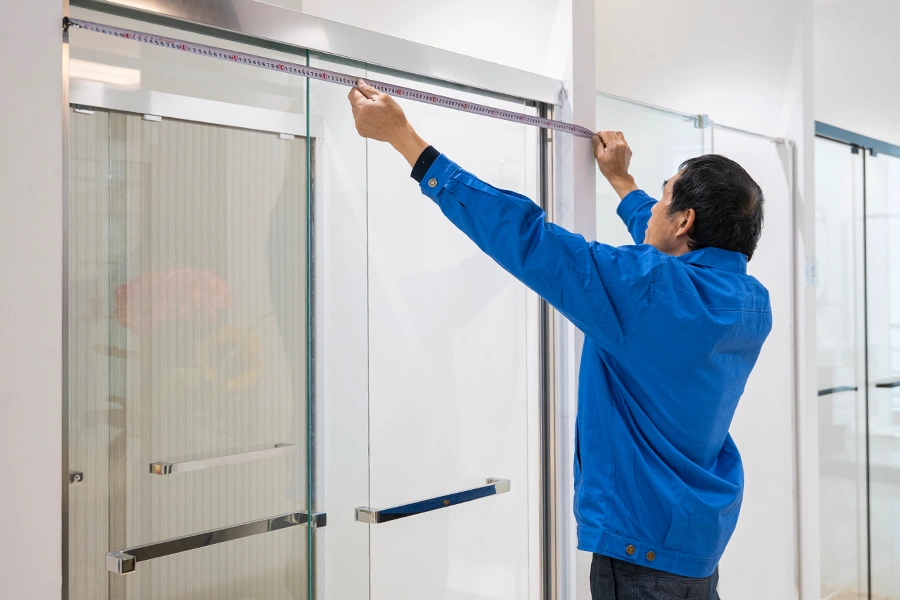
Technician running a push-and-pull functionality test on a shower door glass panel with a digital control rig
★★★★★

“The SGCC directory listing matched the etched label on every panel, and the CE file cleared inspection without a single question.” — Daniel, Hotel Project Purchaser

40+ EN 12150 Particles per 50 mm²
100lb Cat II Shot Bag, CPSC 16 CFR 1201
620–680°C Tempering Furnace Range
1999 Tempered Glass Production Since
Certifications & Standards

Certifications and standards we hold, by market

Every market has its own safety glazing regime. We prepare certification documentation per destination market so your glass clears project review and customs without surprises. These are the marks and standards behind our shower glass.

Certification marks carried by our shower glass

SGCC certification mark of the Safety Glazing Certification Council for certified safety glazing SGCC North America
CE conformity marking required for construction products placed on the European Union market CE European Union
ETL Listed certification mark issued by Intertek confirming product safety testing ETL Listed North America
UL certification mark from Underwriters Laboratories for North American safety standards UL North America
SGCC

Safety Glazing Certification Council

North American safety glass certification with independent lab testing and ongoing, unannounced plant audits.

CE

European Conformity Mark

The legal declaration required for construction products placed on the EU market, backed by type testing.

EN 12150

Thermally Toughened Safety Glass

The European tempering standard. Fragmentation requirement: 40+ particles per 50 mm² for 4–12 mm glass.

ANSI Z97.1

American National Safety Glazing Standard

The US standard defining impact test procedures and pass/fail criteria for safety glazing used in buildings.

AS/NZS 2208

Australian / New Zealand Glass Standard

The safety glass standard for the Australian market, one of our four main export regions since 2006.

ISO

ISO 9001 / 14001 / 45001

Quality, environmental, and occupational health & safety management systems certified manufacturing.

Pain Points → Solutions

What buyers worry about — and what SGCC & CE certification solves

SGCC certified and CE certified shower glass is not a marketing extra. It is the line between a container that clears customs and passes inspection, and one that gets held, rejected, or worse, installed and later involved in an injury claim.

As a shower enclosure factory that has produced tempered glass doors since 1999, we field certification questions from buyers every week. This guide explains what SGCC and CE certification actually cover, how EN 12150 and ANSI Z97.1 differ, and how to verify that a supplier’s certificate is genuine before you wire the deposit.

Shower glass is classified as safety glazing because it sits in a wet, slippery environment where people fall against it at body weight. Ordinary annealed glass breaks into long, razor-sharp shards. Tempered glass, when properly processed, crumbles into small, blunt granules that are far less likely to cause deep cuts. The table below maps the five worries we hear most often to what certification actually does about them.

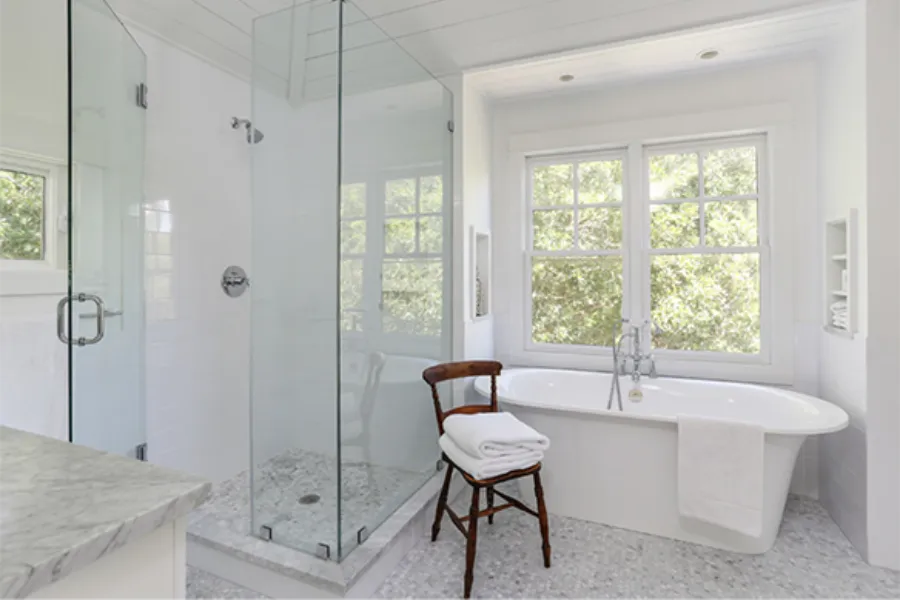
Frameless certified glass shower enclosure surrounding a stone bathtub in a Sheraton Guangzhou Huadu Resort Hotel bathroom
Five-star hotel standard — certified frameless glass installed at the Sheraton Guangzhou Huadu Resort Hotel
Buyer worry Risk without certification What SGCC / CE certification delivers
Glass safety: will a panel shatter and injure a guest? Annealed glass breaks into long, razor-sharp shards; an injury claim follows the property owner and the supplier. Anti-shatter tempered safety glass that granulates instead of sharding, proven by impact testing (100 lb shot bag under CPSC 16 CFR 1201 Cat II; fragmentation count under EN 12150).
Customs clearance: will the container be held at the port? Glazing without recognized documentation can be held, re-inspected, or rejected at import. An SGCC directory-listed plant number and a CE Declaration of Performance that customs and code officials recognize and can verify in minutes.
Project acceptance: will the inspector sign off? US codes reference CPSC 16 CFR 1201 and ANSI Z97.1; European projects follow EN 12150 and EN 14428. Undocumented glass fails inspection and stalls handover. Certification referenced by the very codes inspectors enforce, with test reports and traceable plant numbers that support sign-off.
Liability exposure: what happens if someone is injured later? The first question lawyers ask is whether the glass was certified, and by whom. No paper trail means no defense. A documented chain of third-party testing plus ongoing plant audits that demonstrates due diligence years after installation.
Wholesale acceptance: can I actually list this product? Major North American and European distributors simply will not list uncertified shower doors. Certification that distributors, retailers, and platforms treat as the minimum entry requirement.
North America

What SGCC certification actually means

SGCC stands for the Safety Glazing Certification Council, an independent, non-profit certification body based in the United States. SGCC does not manufacture or test glass itself.

It licenses independent laboratories to test glass samples against the governing standards, then audits the certified plant on an ongoing, unannounced basis.

The standards behind SGCC: ANSI Z97.1 and CPSC 16 CFR 1201

SGCC certifies glass to two US safety standards:

  • CPSC 16 CFR 1201: the federal Consumer Product Safety Commission standard for architectural glazing. Shower enclosures fall under Category II, the highest impact class, which uses a 100 lb (45 kg) shot bag dropped from 48 inches.
  • ANSI Z97.1: the American National Standard that details impact test procedures, specimen sizes, and pass/fail criteria for safety glazing used in buildings.

To pass, the glass must either not break under the impact, or break into fragments small enough and light enough to meet the standard’s injury-limiting criteria. Tempered shower glass almost always passes by breaking safely into granules.

What the SGCC label tells you

Every SGCC certified panel carries a permanent, acid-etched or sandblasted label in one corner. It shows the SGCC logo, the manufacturer’s unique SGCC number, the standard (for example, CPSC 16 CFR 1201 CAT II), and the glass thickness. That number is traceable to a specific certified production line, which is exactly what makes the system hard to fake if you know how to check it.

CPSC 16 CFR 1201 Cat II ANSI Z97.1 Unannounced plant audits Etched plant number
SGCC certification mark that is permanently etched into the corner of every certified shower glass panel
The SGCC mark — acid-etched into a corner of every certified panel together with the traceable plant number
Frameless certified glass shower enclosure on a marble platform beside a freestanding bathtub in a Marriott guest bathroom in Cranberry Township, Pennsylvania
Certified glass in the field — frameless shower enclosure at a Marriott guest bathroom in Cranberry Township, PA
Europe

CE certification for shower glass in Europe

CE marking is the European conformity mark. Unlike SGCC, which is a voluntary third-party certification program, CE marking is a legal declaration by the manufacturer that the product meets the applicable European harmonized standards.

For shower glass, two standards matter most.

EN 12150: thermally toughened safety glass

EN 12150 defines the requirements for thermally toughened soda-lime silicate safety glass. Its core test is the fragmentation test: a 1100 mm by 360 mm specimen is broken, and the number of crack-free particles in a 50 mm by 50 mm count region must meet the minimum threshold (40 particles for glass 4 to 12 mm thick). It also covers tolerances, fragmentation, and mechanical strength.

EN 14428: the shower enclosure product standard

EN 14428 applies to the finished shower enclosure, not just the glass pane. It covers impact resistance, shatter properties, durability of the enclosure under repeated use, and corrosion resistance of the enclosure system. A CE marked shower enclosure should declare conformity to EN 14428 with the glass component meeting EN 12150. When a supplier says “CE certified shower glass,” ask which standard and which test report they mean, because the glass-only EN 12150 route and the full-enclosure EN 14428 route are different claims.

EN 12150 EN 14428 40+ particles / 50 mm²
CE marking declared by the manufacturer for shower glass placed on the European Union market
The CE mark — a legal declaration by the manufacturer, backed by EN 12150 / EN 14428 type testing
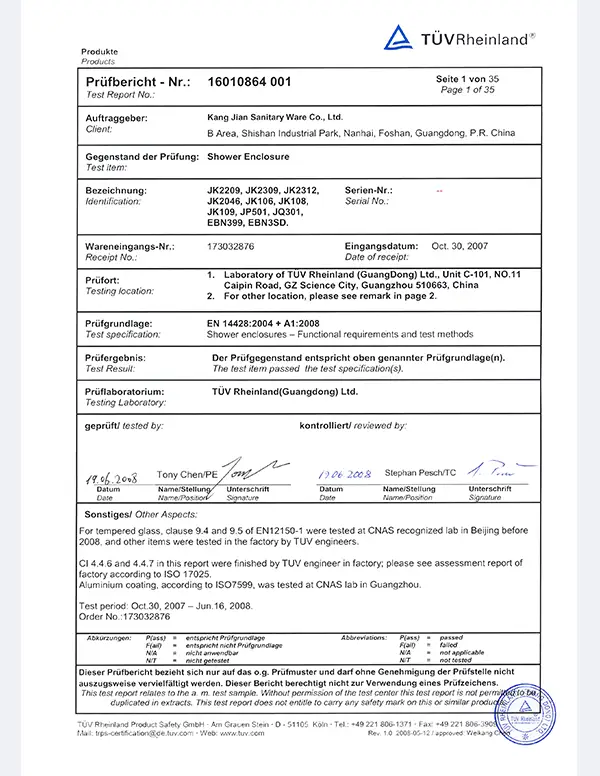
TUV Rheinland test report page for Kang Jian shower enclosures tested according to EN 14428:2004+A1:2008
Third-party test report — shower enclosures tested to EN 14428:2004+A1:2008 by TÜV Rheinland
Testing

How tempered shower glass is actually tested

Understanding the tests helps you read a test report instead of just filing it. Tempered glass starts as cut and edge-worked float glass, then passes through a tempering furnace at roughly 620 to 680 degrees Celsius, followed by rapid quenching with high-pressure air.

That process locks compressive stress into the surface, which is why the glass is four to five times stronger than annealed glass and why it granulates instead of sharding.

The fragmentation test

A specimen is struck with a pointed punch 25 mm from an edge. Inspectors then count particles in the coarsest 50 mm square region, excluding a border zone. EN 12150 requires at least 40 particles per 50 mm square for standard thicknesses. ANSI Z97.1 evaluates that the ten largest crack-free particles weigh no more than the equivalent of 10 square inches of the specimen.

The impact test

Under CPSC 16 CFR 1201 Category II, a 100 lb lead shot bag swings into the center of the glass from a 48-inch drop height. Under EN 14428, a twin-tire pendulum body impact test simulates a person falling against the enclosure. Either the glass survives, or it breaks into fragments that meet the safety criteria. Both outcomes can pass; sharp shards always fail.

From the Factory Floor

The difference between pass and fail often comes down to furnace discipline. If quench pressure or conveyor speed drifts, fragmentation counts drop. That is why SGCC’s unannounced plant audits matter, and why a one-off test report from years ago proves far less than a current certification.

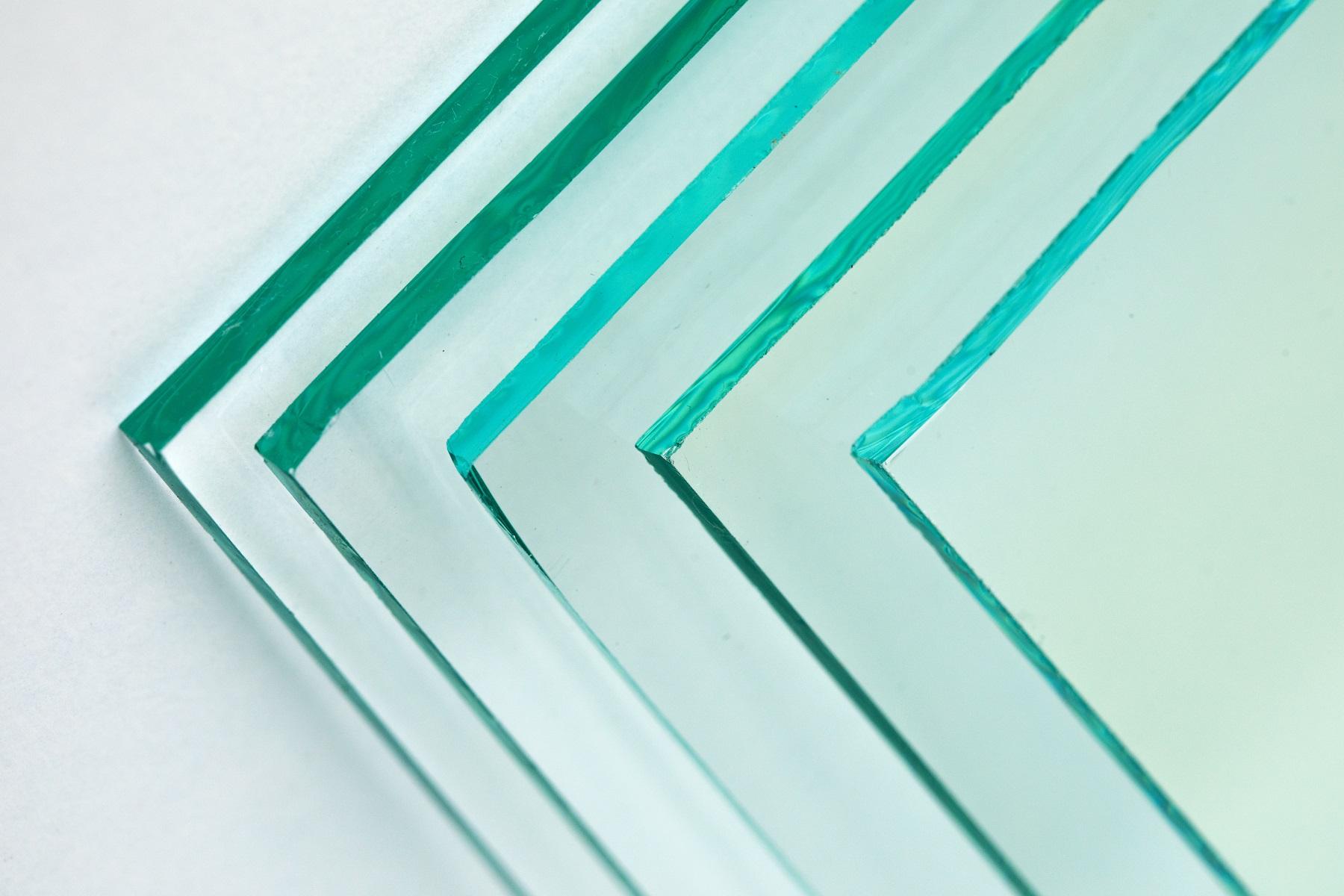
Close-up of four overlapping tempered glass sheets showing green tinted polished edges on a white surface
Tempered glass sheets — polished, green-tinted edges show the edge work that precedes the 620–680°C tempering cycle
KJbath worker in a protective glove swinging a hammer at a panel on sawhorses during an impact resistance demonstration
Impact demonstration — full-force hammer blows that certified panels must survive or safely granulate through
Side by Side

SGCC vs CE: key differences at a glance

Buyers selling into both markets often ask whether one certificate covers the other. It does not. The table below summarizes the practical differences.

Aspect SGCC (North America) CE (Europe)
Target market United States and Canada European Union and EEA
Governing standards ANSI Z97.1, CPSC 16 CFR 1201 Cat II EN 12150, EN 14428
Certification type Voluntary third-party certification with ongoing plant audits Manufacturer declaration, backed by initial type testing
Key test focus Impact resistance with 100 lb shot bag; safe breakage pattern Fragmentation particle count (40+ per 50 mm²); enclosure system durability
Marking Permanent etched label with unique SGCC plant number CE mark plus Declaration of Performance (DoP)
Verification route SGCC online certified products directory DoP document and notified body test reports
Market requirement Effectively mandatory through US building codes and retailer policy Legally required for products placed on the EU market

Serious export factories hold both. At our plant, the same tempering line produces glass for US and EU programs, but each market’s documentation, labeling, and testing schedule runs separately. For Australian projects we work to AS/NZS 2208, the third main standard in our export mix.

Verification

How to verify SGCC and CE certificates before you buy

Certificates are PDFs, and PDFs are easy to fabricate. Verification takes about fifteen minutes and can save a container-load of trouble.

  1. Check the SGCC online directory. SGCC publishes a searchable certified products directory on sgcc.org. Ask the supplier for their SGCC number, then confirm the company name, plant location, and certified glass thicknesses match what you are buying.
  2. Inspect the etched label on a sample. Order a production sample and check the corner mark. The SGCC number etched in the glass must match the directory entry. A printed sticker is not a valid substitute for the permanent mark.
  3. Request the Declaration of Performance for CE. For EN 12150 glass and EN 14428 enclosures, the manufacturer must issue a DoP referencing the test reports and, where applicable, the notified body. Cross-check the report number and date with the issuing laboratory.
  4. Match the certificate to the actual product. A certificate for 6 mm glass does not cover your 10 mm frameless door. Confirm thickness, glass type, and processing (holes, notches, edge work) fall within the certified scope.
  5. Check validity and plant address. Certification follows the factory, not the trading company. If the certificate belongs to a plant in one city but goods ship from another, ask why.
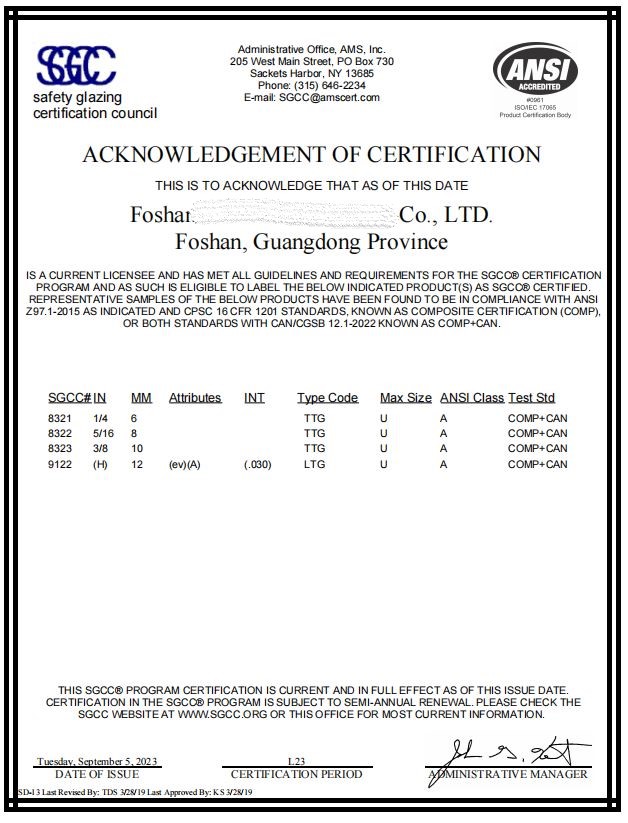
SGCC certificate for Foshan tempered safety glass 6 mm to 10 mm compliant with ANSI Z97.1-2015 and CPSC 16 CFR 1201
What genuine paper looks like — SGCC certificate covering 6–10 mm tempered glass to ANSI Z97.1-2015 and CPSC 16 CFR 1201
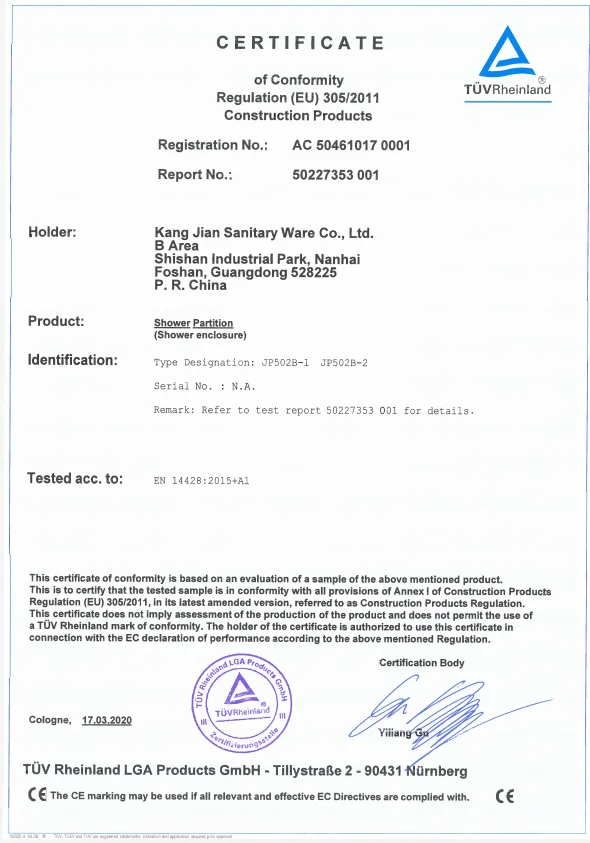
TUV Rheinland CE certificate confirming Kang Jian shower enclosures comply with EN 14428:2015+A1
TÜV Rheinland CE certificate — shower enclosures declared conformant to EN 14428:2015+A1
Red Flags

Common red flags when sourcing certified shower glass

After two decades of supplying hotels and distributors, we have seen most of the tricks. Watch for these.

  • Blurred or expired certificates where the SGCC number or issue date is unreadable. Legitimate suppliers share clear copies.
  • “CE certified” claims with no DoP and no referenced standard. CE without EN 12150 or EN 14428 named in writing is just two letters.
  • Certificates in a trading company’s name. Glass certification belongs to the tempering plant. A middleman cannot hold glass certification for someone else’s factory.
  • Sample glass with an etched label, mass production without it. Specify in the purchase contract that every panel carries the permanent certification mark, and inspect a random carton at loading.
  • Quotes far below market. Proper tempering, testing fees, and audit costs add real cost. A price 20 percent under every other certified supplier usually means the certification is borrowed.
KJbath factory entrance with Shower KJ building signage and a container truck loading certified shower glass for export
Certification follows the factory — audits are tied to the tempering plant in Foshan, not to a trading company address
Why Trust This Guide

Based on 25+ years of certified glass manufacturing

This guide is written by KJbath, a shower enclosure factory founded in 1999 (25+ years of production) with a 15,000 m² self-owned plant in the Shishan Industrial Park, Foshan, Nanhai.

Based on 190+ Countries of Export Experience

Our 151-person team (20 sales / 12 R&D / 120 production) runs four in-house workshops — aluminum processing, glass deep processing, assembly, and automatic packaging — with a flexible monthly capacity of 1,000 sets. We export to 190+ countries and regions, with main markets in North America (US / Canada), Europe (UK / Italy / Germany), Australia, and Southeast Asia.

Engineered for Excellence, Trusted by Five-Star Hotels. Our certified shower glass has been specified for projects under brands including Hilton, Marriott, Hyatt, Doubletree, Hilton Garden Inn, Embassy Suite Hotel, Element, and Firekeepers Casino Hotel — buyers who verify certificates before every order.

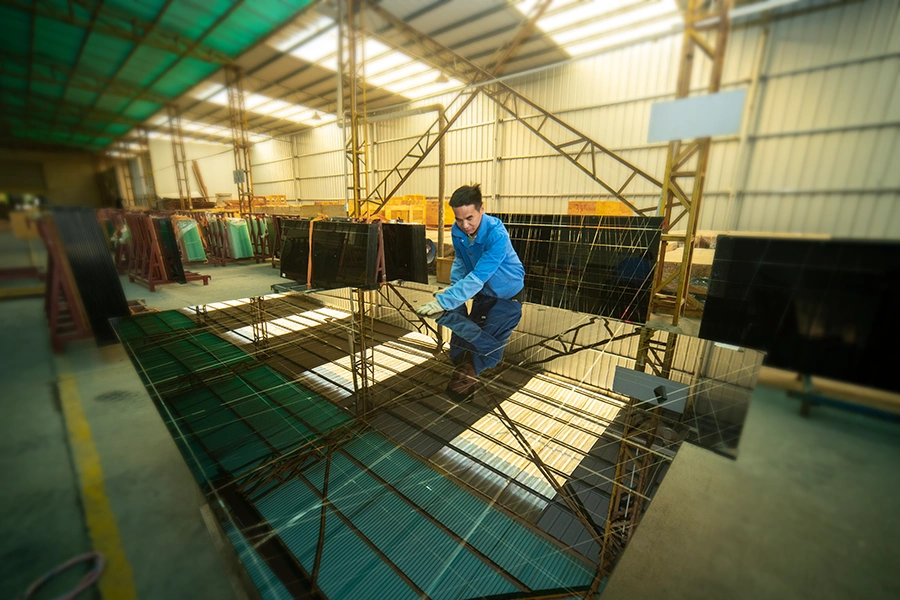
KJbath factory worker in white gloves inspecting a large tempered glass panel on a metal workbench
Incoming glass inspection — every Xinyi substrate is checked before it enters the tempering line
Raw Material

Xinyi glass substrates

Our core raw material is Xinyi glass (信义玻璃原片). Starting from qualified float glass substrates and controlling every tempering parameter in-house is what keeps fragmentation counts and impact results consistent, batch after batch.

Systems

ISO three-system certified

ISO 9001 (quality), ISO 14001 (environmental), and ISO 45001 (occupational health & safety) certified manufacturing, backed by a 5-year warranty on shower doors and a 3-year warranty on hardware components.

Every Order

Documents with every shipment

Each order ships with 1x quality inspection report (tempering rate / impact / salt spray data), 1x SGCC or CE certificate copy, 1x illustrated installation manual, 1x spare parts kit (rollers / seals), in honeycomb cartons plus a reinforced wooden crate.

Grid of hotel brand partner logos including Hilton, Marriott, Sheraton, Holiday Inn and Hyatt supplied by KJbath
Hotel brand partners — certified shower glass specified under Hilton, Marriott, Sheraton, Holiday Inn, and Hyatt programs
FAQs

Frequently Asked Questions

Six questions our buyers ask most often – covering SGCC and CE requirements, dual certification, cost, renewal, and per-order documentation. Tap a question to read our standard answer.

Is SGCC certification required by law in the United States?

For importersSGCC certification itself is voluntary, but US building codes require shower enclosure glass to meet CPSC 16 CFR 1201 and ANSI Z97.1. SGCC certification is the most widely accepted way to prove compliance, and most retailers, distributors, and inspectors treat it as mandatory in practice.

Does CE marking on shower glass mean it was tested by the EU?

For distributorsNo. CE marking is a self-declaration by the manufacturer, supported by initial type testing to EN 12150 and EN 14428. That is why buyers should request the Declaration of Performance and the underlying test reports rather than relying on the CE mark alone.

Can the same glass be both SGCC and CE certified?

For export buyersYes. Many export-oriented factories, including ours, run dual programs. The physical glass is often produced on the same tempering line, but each market requires its own test reports, documentation, and labeling. Always verify each certification separately.

How much does certified tempered glass cost compared to uncertified glass?

For project buyersCertification typically adds 5 to 12 percent to the glass cost, covering testing fees, plant audits, labeling, and tighter process control. On a hotel project, that premium is trivial next to the cost of a failed inspection, a rejected shipment, or a single injury claim.

How often does a supplier need to renew SGCC certification?

For purchasing managersSGCC certification is continuous rather than a one-time event. Certified plants are subject to unannounced audits, and products are periodically retested. When evaluating a supplier, check that their directory listing is current, not just that a certificate exists.

What certification documents should I receive with each order?

For project buyersEvery order should ship with a quality inspection report (tempering rate, impact, and salt spray data) and an SGCC or CE certificate copy that matches the product actually delivered, plus an illustrated installation manual and a spare parts kit. If a supplier cannot produce the certificate copy and test data for the specific batch you are buying, treat the certification claim as unverified.

Bottom Line

Conclusion

SGCC certified and CE certified shower glass is the baseline for any serious B2B shower enclosure purchase.

Know the standards behind the labels: ANSI Z97.1 and CPSC 16 CFR 1201 for North America, EN 12150 and EN 14428 for Europe, AS/NZS 2208 for Australia. Verify SGCC numbers in the official directory, demand the Declaration of Performance for CE marked product, and confirm the certification scope matches the thickness and processing you are ordering. A supplier that welcomes these checks is telling you something about how they run their factory. If you are sourcing shower enclosures for a hotel or wholesale program and want to review our certification files, test reports, and production samples, our team is ready to walk you through them.

Request Certified Glass Quote Review our certification files, test reports, and production samples with our team.
Back to top
Need a fast quotation? Chat with our export team on WhatsApp.