Shower Door Drop Test: Tempered Glass Strength & Packaging Safety Guide
A shower door drop test is the fastest way to prove that tempered glass, hardware, and export packaging can survive real handling before a container ever leaves the factory. This guide breaks down the 45 kg shot bag impact test behind CPSC 16 CFR 1201 Category II, how 620°C tempering produces 4–5× the bending strength of annealed glass, and the honeycomb-carton-plus-wooden-frame packaging system we have refined since 1999.
“Every crate arrived intact — the drop-test reports matched exactly what we saw on the dock.” — Sofia, Import Buyer
45kgShot Bag, CPSC 16 CFR 1201
457mmCategory II Drop Height
620°CTempering Furnace Temperature
4–5×Bending Strength vs Annealed Glass
01The Problem → Our Solution
Why glass shower doors break in transit — and how we stop it
For e-commerce sellers on Amazon and Wayfair, a broken shower door is never just one lost unit. It is a return, a negative review, and a hit to the listing’s conversion rate.
Logistics damage is one of the most expensive failure modes in the category, and it happens long after the glass leaves the tempering furnace.
The pain: logistics damage drives returns
A panel can pass every lab test and still shatter when a carton slides off a pallet or a corner takes a forklift hit in a distribution warehouse.
Each broken unit means a replacement shipment, a refund, and review damage that outlives the order itself.
Certified glass inside weak packaging is still a returns risk — the glass and the box are one system, and the system has to be tested together.
The KJbath answer: tested glass plus a validated packaging system
Drop-tested tempered glass: every batch is verified against the 45 kg shot bag impact test (CPSC 16 CFR 1201 Category II, 457 mm drop height) and the EN 12150 fragmentation test.
Protective packaging system: a standardized honeycomb carton plus a reinforced wooden frame, validated on our automatic packaging line with corner, edge, and face drop tests.
The result for sellers: a lower logistics damage rate, fewer returns, and protected margin on every shipment.
Tested Together
One system, verified end to end
Glass and packaging are validated as a single unit — 45 kg shot bag impact on the panel, then corner, edge, and face drops on the finished carton — so the protection is proven before loading.
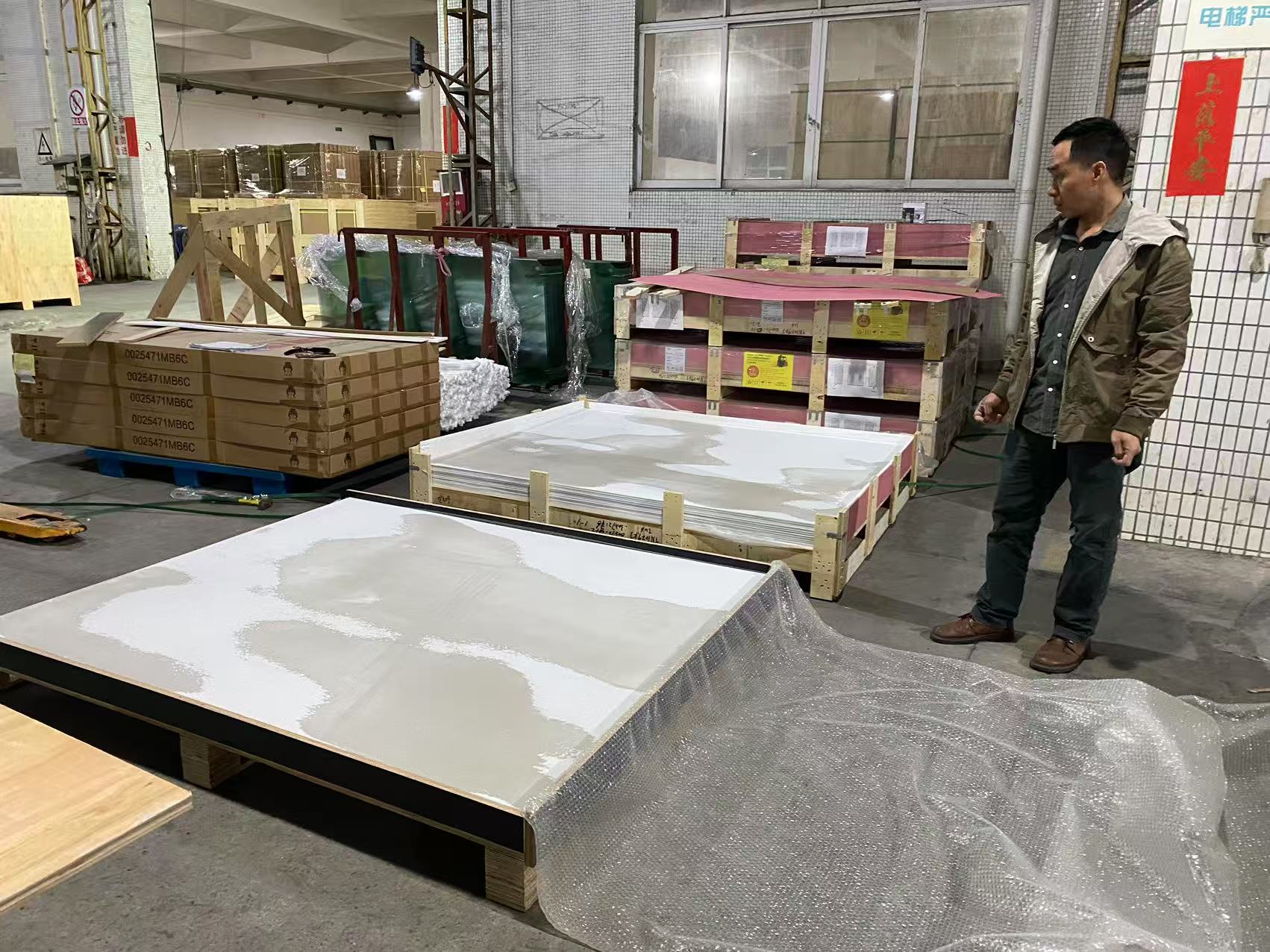
Where damage really happens — panels staged on warehouse pallets, the exact handling environment the packaged drop test is built to survive
02The Basics
What is a shower door drop test?
If you buy shower doors for hotel projects or wholesale distribution, the drop test is one of the few quality checks you cannot afford to skip.
A panel of tempered glass can look perfect on a spec sheet and still fail the first time a carton slides off a pallet or a fitter knocks a corner against a tile wall. A drop test is a controlled impact test where glass, either bare or inside its export packaging, is dropped or struck from a defined height onto a defined surface. The goal is simple: prove that the glass and its protection system can absorb the kind of shocks that happen in transport, warehousing, and installation.
There are really two different tests buyers mix up:
Glass impact tests measure the strength of the tempered glass itself, usually following standards such as EN 12150 or ANSI Z97.1. A weight or pendulum hits the glass, and inspectors check whether it breaks and, if it does, how it breaks.
Packaging drop tests measure the whole shipping unit. The packed carton is dropped on its corner, edges, and faces, following ISTA-style protocols, to prove the packaging protects the glass through the last mile.
A serious supplier runs both. Glass that passes EN 12150 can still arrive broken if the carton is weak, and strong packaging cannot rescue glass that was badly tempered in the first place.
One roof, one system — tempering, impact testing, and export packaging all happen inside the same KJbath facility
03Certifications & Standards
The standards behind every drop test report
When a supplier claims the glass “passed the drop test,” the only claim worth anything is the one tied to a named standard and a traceable certificate. Our tempered shower glass is tested and documented against the four frameworks below, and a certificate copy ships with every order.
CPSC 16 CFR 1201
US Federal Glazing Standard
The US Consumer Product Safety Commission federal standard for architectural glazing. Shower doors fall under Category II, the highest impact class.
ANSI Z97.1
American National Standard
The American National Standard that details impact test procedures, specimen sizes, and pass/fail criteria for safety glazing used in buildings.
SGCC
Safety Glazing Certification Council
The independent US certification body that licenses laboratories to test glass to ANSI Z97.1 and CPSC 16 CFR 1201, then audits the certified plant on an ongoing basis.
CE · EN 12150
European Conformity Route
The European conformity route for thermally toughened safety glass, with EN 14428 covering the finished shower enclosure as a product.
04Impact Standard · Material Science
The shot bag test, 620°C tempering, and safe fragmentation
When a supplier says their glass “passed the impact test,” the useful follow-up question is: which standard, and at what level? In the US market, safety glazing in shower doors must comply with CPSC 16 CFR 1201, which uses a shot bag impact test.
A bag filled with lead shot, weighing about 45 kg (100 lb), swings against the glass from a set drop height. Category II, the level required for shower doors, uses a drop height of 457 mm (18 inches). ANSI Z97.1 uses a similar method and is widely referenced in project specifications.
How tempering changes the glass
Every shower door we ship uses tempered (toughened) safety glass, and there is a straightforward reason: ordinary annealed glass breaks into long, sharp shards that can cause severe injury in a wet, slippery bathroom. Tempered glass is heat treated so that, when it does fail, it crumbles into small, blunt granules instead of blades.
During tempering, the glass is heated to around 620 degrees Celsius and then cooled rapidly with high-pressure air. The surfaces cool and contract faster than the core, which locks the surface into compression. That compressive layer is what gives tempered glass roughly four to five times the bending strength of annealed glass of the same thickness.
Fragmentation: the EN 12150 particle-count rule
Tempering quality is verified with the fragmentation test. A specimen is broken deliberately, and inspectors count the crack-free particles in a 50 x 50 mm zone. EN 12150 requires at least 40 particles per 50 x 50 mm area for standard shower thicknesses (4 to 12 mm). A high particle count means the glass has been properly tempered and will break into small, blunt granules rather than long, cutting shards. Fewer particles than the threshold signals under-tempering, and that batch does not ship.
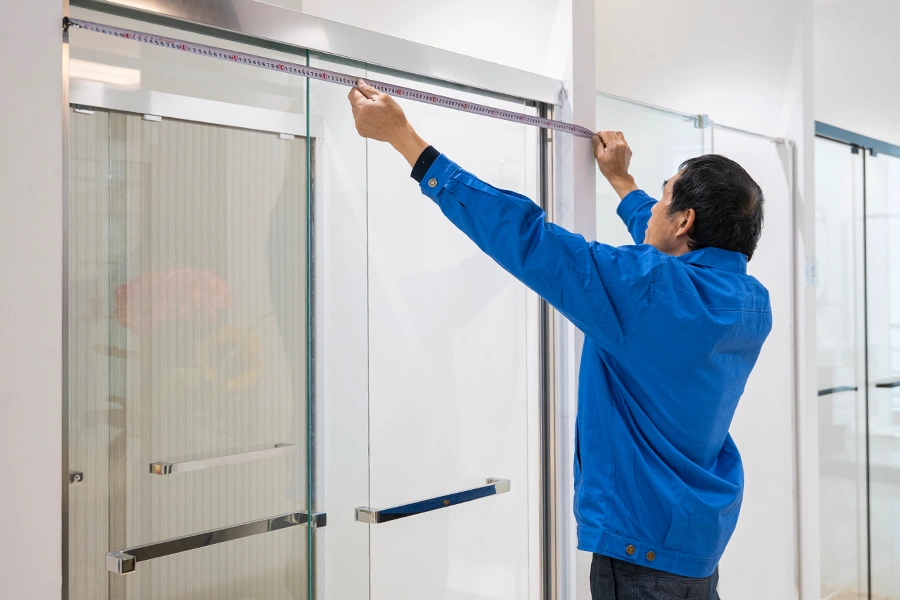
Impact in practice — a controlled strike on a reinforced panel; the CPSC 1201 shot bag test formalizes this with a 45 kg bag dropped from 457 mm
Common thickness options for shower doors
6 mm: economical, works for framed and semi-frameless doors with proper support.
8 mm: the hotel industry workhorse, good balance of weight, rigidity, and cost.
10 mm: standard for frameless doors and large walk-in panels where hardware carries the full load.
Edge Quality
Thickness alone does not guarantee survival in a drop test. Edge quality matters just as much: chips or micro-cracks left by poor grinding become the starting point of a break under impact. That is why we arris and polish every edge before tempering, never after.
05Test Method Comparison
Three test methods, three different questions
Three methods dominate shower glass testing. Each answers a different question, so buyers should know which one a report refers to.
Test method
Typical standard
How it works
What it proves
Shot bag impact
CPSC 16 CFR 1201, ANSI Z97.1
A 45 kg (100 lb) lead-shot bag swings into the glass from a 457 mm Category II drop height
Safe behavior under body-weight impact, the key test for bathroom glazing
Fragmentation test
EN 12150-1
The specimen is broken deliberately and particles in a 50 x 50 mm zone are counted
Tempering quality: breaks into small blunt granules, not shards
Ball drop test
Various in-house and EN 12600-style methods
A steel ball of known weight drops freely onto the glass surface from increasing heights
Surface impact resistance, useful for comparing glass batches and coatings
One practical note on the ball drop test: it is fast and cheap, which makes it ideal for batch sampling on a production line. It does not replace the shot bag test for certification, but it catches weak tempering or edge damage early, before the glass reaches the packing area.
Industry Insight
In our experience, more project disputes come from missing test documentation than from actual glass failures. A one-page certificate with a traceable standard number is worth more than ten pages of marketing claims.
06Factory Perspective
How we run drop tests at the KJbath factory
We have manufactured shower enclosures since 1999, and our testing routine has grown out of real warranty cases, not textbooks. A typical weekly protocol looks like this.
Batch sampling: from every tempering furnace shift, we pull sample panels of each thickness, including the largest door sizes in production.
Fragmentation check: at least one panel per batch is broken deliberately at the center and near a corner. We count particles in the marked zone against EN 12150 requirements. Corner breaks matter most because that is where doors fail in the field.
Ball drop screening: a 1 kg steel ball is dropped from set heights onto sample panels. Any panel that fails below our internal threshold sends the whole batch back for furnace parameter review.
Edge inspection: under angled light, inspectors check every production panel for chips and shelling along the edges, since a damaged edge can cut impact resistance dramatically.
Packaged drop test: finished cartons go to the drop station for corner, edge, and face drops, then we open the carton and inspect the glass under light.
The point of publishing this routine is not to sound impressive. It is to show that drop testing is a process, not a single photo of a hammer hitting glass. When you audit a supplier, ask to see sampling records with dates and batch numbers, not just one dramatic test video.
Based on 25+ Years of Production
Based on 25+ years of tempered glass production and packaging experience, one pattern never changes: glass rarely fails in the middle of a panel. It fails at corners and edges, and it fails in transit when packaging is weak. That is why we test finished, packaged units, not just lab samples.
The process behind the test — an organized KJbath production floor where every station feeds documented samples into the weekly drop-test protocol
07Packaging System
Packaging drop tests: the system that survives the last mile
For export orders, the packaged drop test often matters more than the glass test. A hotel project in Texas or a distributor warehouse in Rotterdam means weeks of vibration, forklift handling, and at least one moment where a carton gets dropped harder than anyone admits.
Our export packaging is a standardized honeycomb carton plus a reinforced wooden frame, assembled on our automatic packaging line, and every run is validated with drop tests tuned to glass:
Corner drop first: the most dangerous orientation for a glass carton. Honeycomb edge protectors and corner blocks absorb the shock before it reaches the glass corner.
Edge and face drops: verify that inner foam density and panel separation keep glass surfaces from flexing into each other.
Hardware isolation: hinges, rollers, and handles travel in independent inner boxes. Loose metal parts scratching or striking glass during vibration is one of the most common hidden causes of breakage claims.
Reinforced wooden frame: the outer wooden frame keeps the carton rigid through stacking and forklift handling, so the honeycomb cushioning does the absorbing instead of the glass.
LCL versus FCL logic: less-than-container shipments face more handling events, so we increase corner protection and add outer reinforcement for LCL orders.
Why this matters for e-commerce sellers: on Amazon and Wayfair, the logistics damage rate is what drives returns and negative reviews. Drop-validated honeycomb cartons and reinforced wooden frames lower that damage rate, which protects your margin and your listing on every shipment.
A simple field check for buyers: when your first shipment arrives, inspect carton corners before signing. Crushed corners with intact glass mean the packaging did its job. Intact cartons with broken glass usually point back to the glass itself or to poor internal separation.
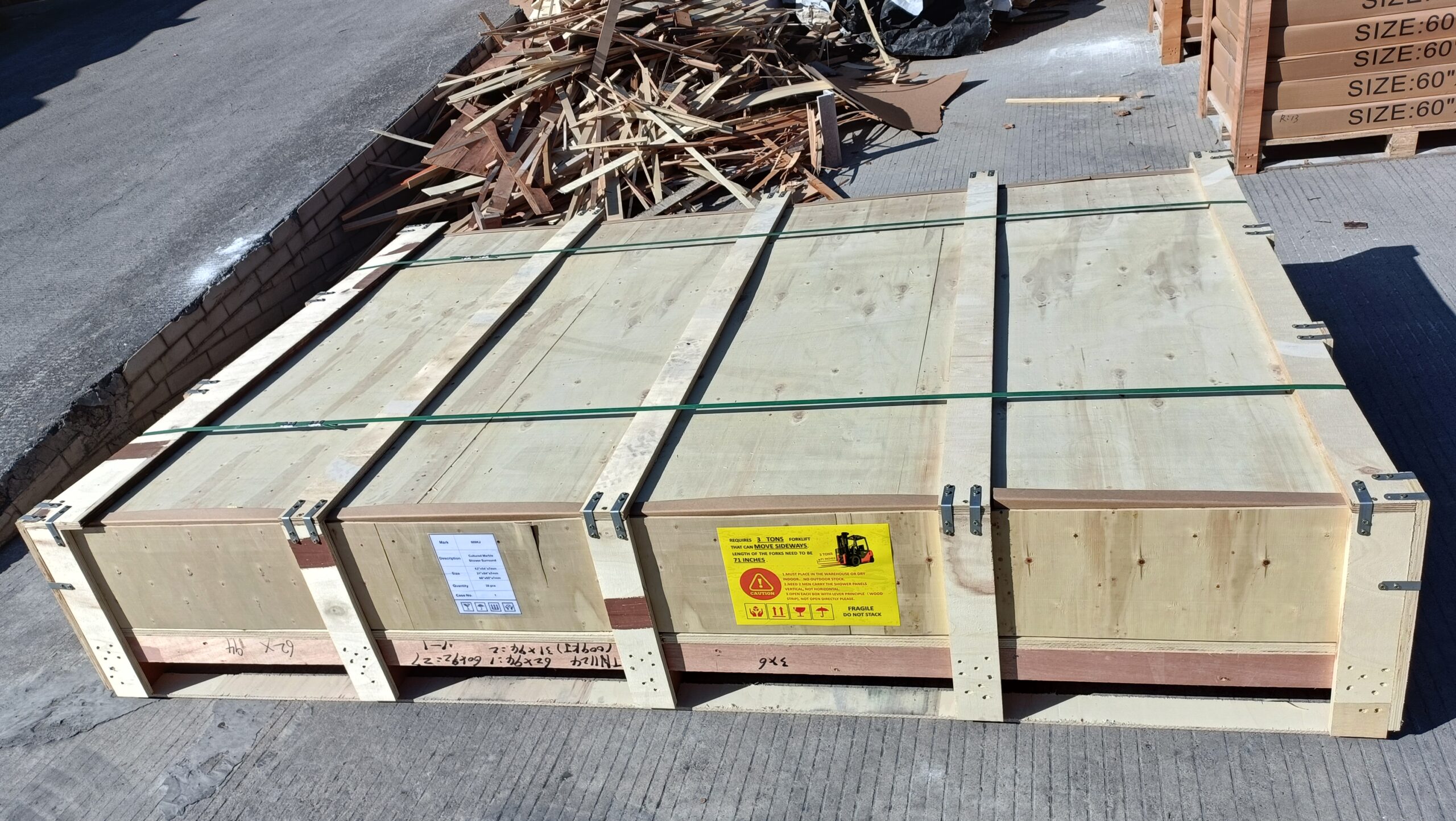
Export packaging — a reinforced wooden frame with corner brackets, strapping, and handling labels that tell the whole logistics chain how to treat the glass
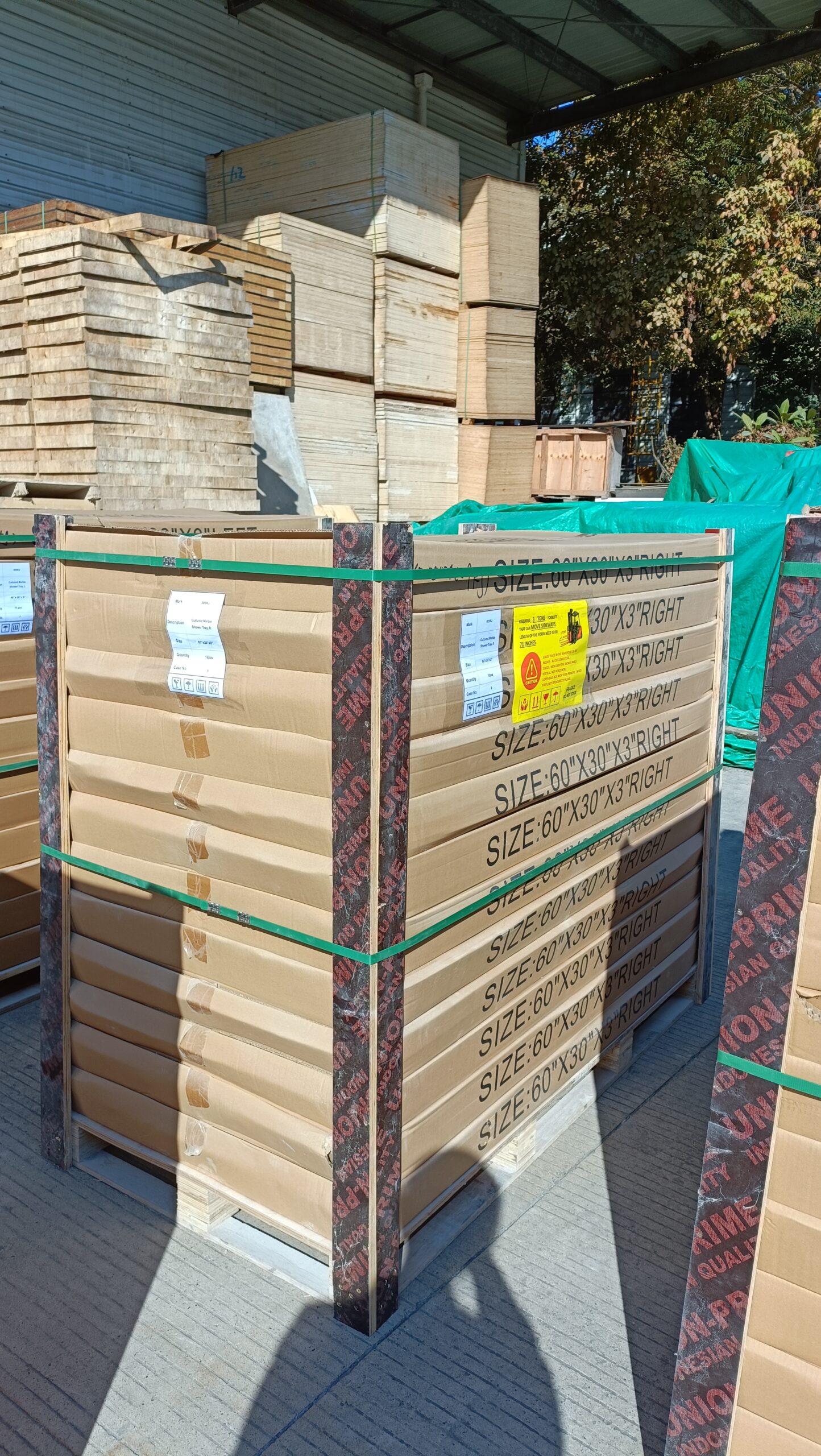
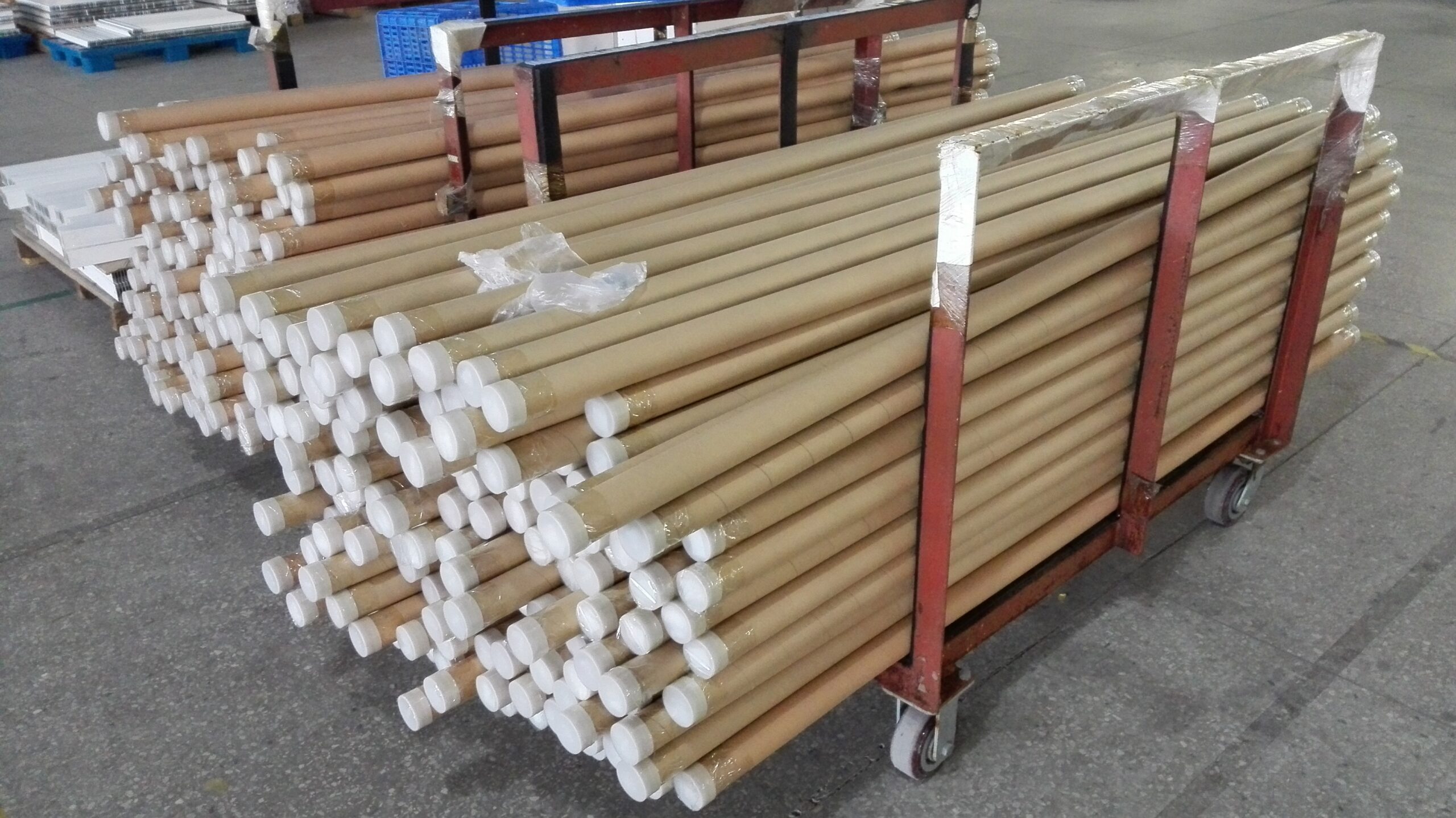
Strapped for the container — honeycomb layers and corner protectors held rigid under green strapping for ocean freightPackaging material staging — honeycomb paper tubes on a wheeled cart, ready to feed the automatic packaging line
08Buyer Checklist
What buyers should ask before placing an order
Whether you source for a 300-room hotel or a regional wholesale program, these questions separate serious factories from trading companies with a test video.
Which standards does your glass meet, and can you share certificates for EN 12150, EN 14428, or CPSC 16 CFR 1201 with traceable numbers?
Do you run fragmentation tests per tempering batch, and can we see sampling records?
What is your packaged drop test protocol for LCL shipments?
How is hardware isolated from glass inside the carton?
What is your documented breakage rate on export orders, and how do you handle claims?
A factory that tests seriously will answer these quickly, with documents. Vague answers at this stage tend to become expensive emails later. If you are sourcing shower enclosures for a hotel, wholesale, or e-commerce program, send us your project and channel details and we will share the relevant test reports and packaging specification.
FAQs
Frequently asked questions about the shower door drop test
Six questions our buyers ask most often – covering drop test versus shot bag test, certification, glass thickness, supplier verification, and e-commerce packaging. Tap a question to read our standard answer.
Does tempered shower glass really need a drop test if it is already certified?
For quality inspectorsYes. Certification covers the glass type, not every production batch. Tempering quality drifts with furnace conditions, glass thickness, and edge finishing, so batch-level drop and fragmentation testing is what keeps certified performance consistent in real shipments.
What is the difference between a drop test and a shot bag test?
For project buyersA shot bag test, defined by CPSC 16 CFR 1201 and ANSI Z97.1, simulates a person falling against the glass and is the formal safety test. A drop test usually refers to dropping the packaged product or dropping a weight such as a steel ball onto the glass. They answer different questions and good factories run both.
Can a shower door pass impact tests and still break after installation?
For installersIt can. Nickel sulfide inclusions, edge damage during installation, or hardware over-tightening can cause spontaneous breakage months later. This is why edge polishing quality and correct installation torque matter as much as the lab test results.
Is 8 mm or 10 mm glass safer for hotel shower doors?
For hotel developersBoth pass the same safety standards when properly tempered. Ten millimeter glass offers more rigidity for frameless designs, while 8 mm is lighter and easier on hinges over thousands of open-close cycles. The safer choice is the one matched to the door configuration and hardware, not simply the thickest option.
How do I verify a supplier actually performs drop tests?
For importersAsk for batch sampling records with dates, photos of the drop station, and a live video call during a test if you are placing a large order. Reputable factories treat this as a routine request, not an insult.
How does drop-tested packaging reduce e-commerce return rates?
For e-commerce sellersDrop-validated packaging – a standardized honeycomb carton plus a reinforced wooden frame, tested with corner, edge, and face drops – lowers the logistics damage rate that drives returns and negative reviews on Amazon and Wayfair. Fewer broken units means fewer replacement shipments and protected margin on every order.